Overview
Course Content
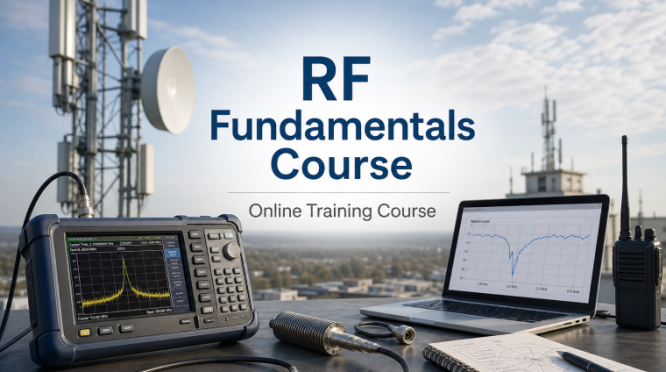
The RF Fundamentals Course builds practical knowledge of how radio signals are generated, transported, propagated, measured, and received. Learners examine frequency, wavelength, spectrum, power, decibels, transmission losses, antennas, propagation, line-of-sight requirements, interference, and receiver performance. Technician-focused examples connect theory to coverage planning, installation, testing, and fault diagnosis. By completing the course, learners can interpret common RF specifications, perform basic calculations, recognize conditions that degrade wireless links, and make safer, better-informed field decisions across land-mobile radio, cellular, microwave, and satellite systems.
Verified Satoms Course Rating
RF Fundamentals Course
Based on 45 learner reviews
Course Level: Beginner
What You Will Learn
- Explain the complete RF signal path
- Relate frequency, wavelength, and spectrum allocation
- Calculate RF power, gain, and loss using decibels
- Identify major radio propagation mechanisms
- Evaluate path loss, line of sight, and Fresnel clearance
- Describe antenna and receiver performance
- Complete basic RF link and measurement calculations
Who This Course Is For
- Radio communications technicians
- Telecommunications field technicians
- Microwave, satellite, cellular, and wireless technicians
- Network engineers and support personnel
- RF installation and maintenance personnel
- Apprentices and technical trainees
Course Benefits
- Builds a strong foundation for advanced radio technologies
- Improves RF installation and troubleshooting decisions
- Develops confidence with dB and dBm calculations
- Connects RF theory to field conditions
- Supports further study of P25, TETRA, DMR, LTE, 5G, microwave, and satellite systems
Assessment and Certificate
Confirm your understanding of RF principles, calculations, propagation, antennas, interference, measurements, and basic link analysis.
Pass mark: 80%
Requirements
- Basic arithmetic skills
- General telecommunications awareness
- Calculator for practical exercises
- No prior RF theory required
Frequently Asked Questions
What does the RF Fundamentals Course cover?
It covers radio signals, frequency, wavelength, spectrum, power, decibels, transmission losses, antennas, propagation, interference, receiver performance, and basic RF calculations.
Who is the RF Fundamentals Course for?
It is for radio communications and telecommunications field technicians, wireless technicians, network engineers, RF installation and maintenance personnel, apprentices, and technical trainees.
What are the requirements for this course?
Learners need basic arithmetic skills, general telecommunications awareness, and a calculator for practical exercises. No prior RF theory is required.
What will learners be able to do after completing the course?
Learners will be able to interpret common RF specifications, perform basic calculations, recognize conditions that degrade wireless links, and make better-informed field decisions.
Related Courses
Curriculum
- 5 Sections
- 11 Lessons
- Lifetime
Expand all sectionsCollapse all sections
- Module 1: RF Principles3
- Module 2: Signal Transport and Propagation3
- Module 3: Antennas and RF Links4
- Module 4: Completion1
- Module 5: Assessment1