20% off
Data Center Essentials
Choose 2 to 3 courses.
Professional Online Training
Learn how electricity reaches critical IT equipment, what keeps it available during a supply change, and how to recognize developing power issues without crossing electrical safety boundaries.
Written by industry experts with over 20 years of practical experience, this excellent-quality Satoms training builds useful knowledge and confidence and leads to a Satoms training certificate after successful completion of the course requirements.
Start Your Training Today
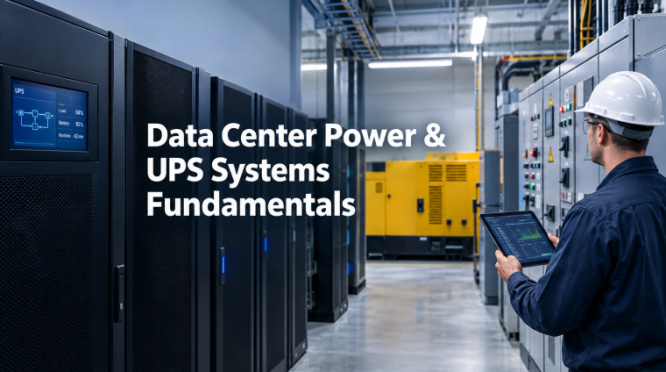
Enroll in Data Center Power & UPS Systems Fundamentals and begin learning online at your own pace.
A power alarm is easier to assess when you understand how sources, UPS systems, and downstream equipment work together. This course connects essential concepts to the inspections, monitoring, maintenance support, and incident handovers encountered in data center operations. It helps you ask better questions, check appropriate information, and recognize when a condition needs qualified attention.
Satoms provides excellent-quality, practical online training designed to build useful knowledge and confidence. Written by industry experts with over 20 years of practical experience, the course offers a clear, self-paced learning experience that takes approximately seven hours of study. Real course reviews are displayed separately on this page so you can consider learner feedback as you decide.
This beginner-to-intermediate course suits people who work with, support, or need to understand critical power infrastructure, including:
Understanding upstream and downstream dependencies can help you identify affected equipment more quickly when a power issue occurs. Distinguishing an expected source transfer from a warning condition supports more informed operational decisions, while basic capacity and battery knowledge helps you raise concerns for review before they are overlooked.
You will also be better prepared to communicate during an incident. By recording equipment status, trends, and a timeline, you can provide a clearer handover to the people responsible for investigation or repair. Throughout the course, the emphasis remains on safe observation and escalation—not performing electrical work without the required authorization, controls, and qualifications.
You will receive a Satoms training certificate after successfully completing the course requirements. These include a final assessment of 20 questions covering the power path, equipment operation, monitoring, safety, and fault response. Each attempt has a 60-minute time limit; you need 80% to pass and have up to three attempts in total.
No. Basic electrical terminology is helpful, but the course introduces UPS operation and the wider data center power path.
Allow approximately 7 hours for self-paced online study.
No. Electrical switching, testing, and maintenance require appropriate qualifications, site authorization, and applicable safety procedures.
It has 20 questions, a 60-minute limit per attempt, an 80% pass mark, and three total attempts: one initial attempt and two retakes.
Students receive a Satoms training certificate after successfully completing the course requirements.
Yes. It explains how UPS systems, batteries, standby generators, and transfer switches support the critical power path.
The Data Center Power & UPS Systems Fundamentals course helps students build practical knowledge, improve confidence, and understand the key concepts needed for the subject. It is designed as professional online training for Data center technicians and facility operators, Electrical maintenance and critical infrastructure technicians and provides clear lessons that can be completed at your own pace.
Satoms provides a money-back guarantee for added confidence when enrolling in training. This helps students choose the course with less risk while still receiving professional online training and support.
Choose 2 to 3 courses.
Not a member yet? Create an account
Already a member? Log In