Overview
Course Content
Professional Online Training
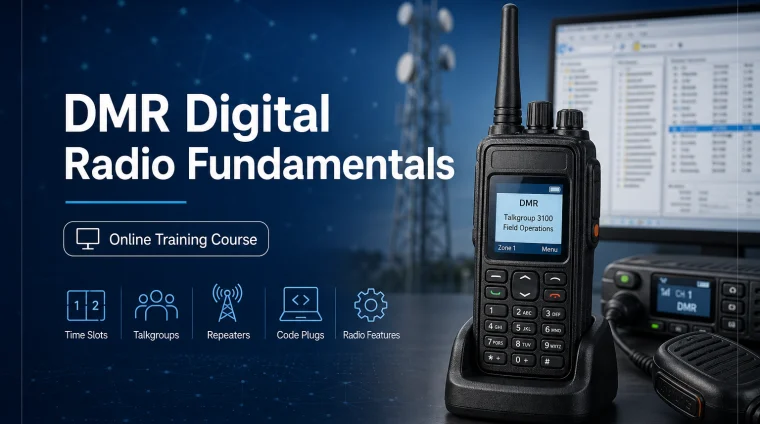
Build Practical Knowledge with DMR Digital Radio
Understand how DMR digital radio systems operate so you can support users, interpret programming settings, and troubleshoot common problems more effectively.
Written by a ex-military telecommunications specialist with over 25 years of digital radio experience, this excellent Satoms training builds confidence and provides a Satoms training certificate after successful completion.
Start Your Training Today
Enroll in DMR Digital Radio Fundamentals and develop practical digital radio knowledge at your own pace.
Verified Satoms Course Rating
DMR Digital Radio Fundamentals
Based on 89 learner reviews
Course Level: Intermediate
Course information last reviewed: June 2026
What You Will Learn
Develop a clear working foundation in the ETSI DMR standard and the concepts used across commercial, industrial, public service, and amateur radio systems.
- Explain what DMR is and why it is widely used for digital two-way radio communications.
- Compare DMR with analog FM radio in terms of audio, signaling, capacity, and available features.
- Distinguish between Tier I, Tier II, and Tier III DMR system structures.
- Interpret how time slots, color codes, talkgroups, contacts, and zones work together.
- Describe how DMR repeaters extend coverage and support two simultaneous voice paths on one channel.
- Understand how code plugs are organized and why accurate programming is essential.
- Identify common user, programming, coverage, and repeater-related problems.
- Apply practical troubleshooting steps before escalating a suspected fault.
Why Train with Satoms
Satoms provides excellent-quality, practical online training designed to turn technical concepts into useful knowledge. Lessons are written by industry experts with over 20 years of practical experience, helping you focus on how DMR terminology, settings, and system behavior apply in real operating environments.
The clear online learning experience allows you to progress at your own pace, revisit important concepts, and build confidence without unnecessary theory overload. Real course reviews are displayed separately on this page, so you can consider genuine learner feedback when deciding whether the training meets your needs.
Who This Course Is For
This course is suitable for practical learners who operate, support, maintain, or want to understand DMR radio systems.
- Field technicians working with two-way radio equipment.
- Technical employees supporting DMR users or radio fleets.
- Digital radio users moving from analog FM systems to DMR.
- Maintenance teams handling repeaters, code plugs, or coverage issues.
- Supervisors and coordinators responsible for operational radio communications.
- Existing Satoms students seeking a stronger foundation in digital radio.
Course Benefits
Completing this training can help you approach DMR operation and support tasks with a more structured understanding.
- Communicate more accurately with radio users, technicians, and system support teams.
- Review code plug settings more methodically before making or requesting changes.
- Separate likely user, programming, coverage, and repeater faults during initial checks.
- Avoid confusion when discussing talkgroups, time slots, color codes, zones, and repeater access.
- Support users with clearer explanations of expected DMR radio behavior.
- Build a sound foundation for further study of connected repeaters, system design, and trunked radio networks.
Training Certificate on Completion
After successfully completing the course requirements, including the course assessment, you will receive a Satoms training certificate. The assessment checks your understanding of essential DMR concepts, system operation, code plug structure, repeater use, and basic troubleshooting. Your certificate provides a useful record of completed professional technical training.
Course Requirements
- Basic familiarity with two-way radio operation is helpful but not required.
- No advanced RF engineering knowledge is needed.
- Access to a DMR radio or programming software can support practice but is not mandatory.
- A willingness to learn practical radio terminology, system behavior, and troubleshooting methods is recommended.
Frequently Asked Questions
What is the DMR Digital Radio Fundamentals course?
DMR Digital Radio Fundamentals is a practical online course that explains how Digital Mobile Radio systems work, including Tier II, Tier III, talkgroups, time slots, repeaters, code plugs, roaming, and common troubleshooting methods.
Who should take this DMR training course?
This course is ideal for field technicians, radio users, support teams, technical employees, and beginners who need a clear working understanding of DMR digital radio systems and fleet operation.
Will this course help me work more confidently with DMR radios?
Yes. The lessons connect DMR concepts to real operational situations so you can understand settings, identify common configuration problems, and approach faults with a more structured troubleshooting process.
What practical benefits will I gain from the course?
You will learn how DMR channels, talkgroups, color codes, repeaters, code plugs, and network features interact, helping you support users, communicate with radio specialists, and diagnose common system issues more effectively.
Is the course suitable for beginners?
Yes. The course starts with core DMR principles and builds toward practical system behavior, making it suitable for beginners while still useful for technicians who want to strengthen their fundamentals.
Why is Satoms DMR training credible?
Satoms courses are built for technical learners and focus on accurate, field-relevant explanations. The training uses professional structure, realistic examples, and practical terminology used in radio communications environments.
Do I receive a certificate after completing the course?
Yes. Learners who complete the course requirements and pass the final assessment receive a Satoms certificate, which can support professional development, workplace training records, and evidence of completed technical learning.
Does Satoms offer a money-back guarantee?
Satoms provides a money-back guarantee for added confidence when enrolling in training. This helps students choose the course with less risk while still receiving professional online training and support.
Related Courses
Curriculum
- 6 Sections
- 18 Lessons
- Lifetime
Expand all sectionsCollapse all sections
- Module 1: DMR Foundations3 Items
- Module 2: DMR Air Interface and System Types4 Items
- Module 3: Talkgroups, Repeaters, and Network Operation4 Items
- Module 4: Programming, Code Plugs, and Practical Configuration3 Items
- Module 5: Operation, Maintenance, and Troubleshooting4 Items
- Module 6: DMR Digital Radio Assessment1 Item