Overview
Course Content
Course Video
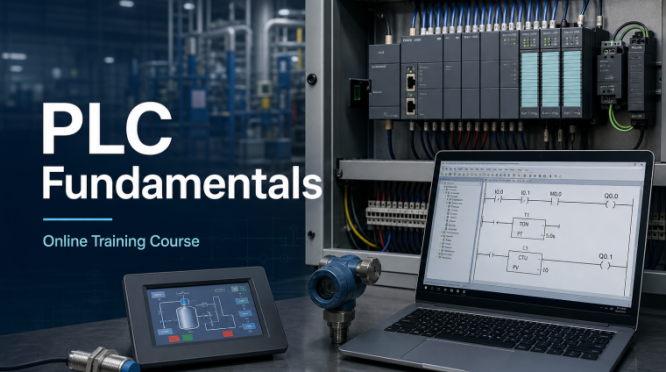
This course builds practical knowledge of Programmable Logic Controllers (PLC) used in industrial automation. Learners examine PLC hardware, digital and analog I/O, the scan cycle, ladder logic, timers, counters, communications, and diagnostic tools. Field-focused lessons explain how controllers interface with sensors, transmitters, actuators, HMIs, and SCADA systems. Learners also practice interpreting basic control logic and applying structured fault-finding methods.
The course supports technicians, electricians, and maintenance personnel who need a credible foundation for working safely and effectively with PLC-controlled equipment.
Verified Satoms Course Rating
PLC Fundamentals
Based on 1,128 learner reviews
Course Level: Intermediate
What You Will Learn
- Explain PLC functions and control-system architecture
- Identify PLC hardware and module functions
- Differentiate digital and analog I/O signals
- Describe the PLC scan cycle and operating modes
- Interpret and develop basic ladder logic
- Apply timers, counters, comparisons, and interlocks
- Recognize common industrial communication methods
- Monitor PLC operation and perform basic fault-finding
Who This Course Is For
- Electrical and instrumentation technicians
- Industrial maintenance and automation technicians
- SCADA and control technicians
- Plant, process, and field service technicians
- Industrial telecommunications technicians
- Apprentices and technical trainees
- Maintenance and operations personnel
- Personnel entering industrial automation roles
Course Benefits
- Build job-relevant PLC knowledge
- Improve control-system troubleshooting confidence
- Interpret basic PLC programs more effectively
- Understand connections between controllers and field devices
- Prepare for vendor-specific PLC training
Assessment and Certificate
Confirm your understanding of PLC hardware, I/O, scan operation, ladder logic, instructions, communications, and basic diagnostic practices.
Pass mark: 80%
Requirements
- Basic electrical knowledge
- Familiarity with industrial equipment
- Access to a computer or mobile device
- No previous PLC programming experience required
Frequently Asked Questions
What topics does the PLC Fundamentals course cover?
It covers PLC hardware, digital and analog I/O, the scan cycle, ladder logic, timers, counters, communications, monitoring, and basic diagnostic practices.
Who is the PLC Fundamentals course for?
It is intended for technicians, apprentices, maintenance and operations personnel, technical trainees, and people entering industrial automation roles.
Do I need previous PLC programming experience?
No previous PLC programming experience is required, but basic electrical knowledge and familiarity with industrial equipment are listed as requirements.
Related Courses
Curriculum
- 5 Sections
- 11 Lessons
- Lifetime
Expand all sectionsCollapse all sections
- Module 1: PLC Systems and Hardware3 Items
- Module 2: Signals and Controller Operation2 Items
- Module 3: PLC Programming Fundamentals3 Items
- Module 4: Integration, Diagnostics, and Review3 Items
- Module 5: Assessments1 Item