Overview
Course Content
Professional Online Training
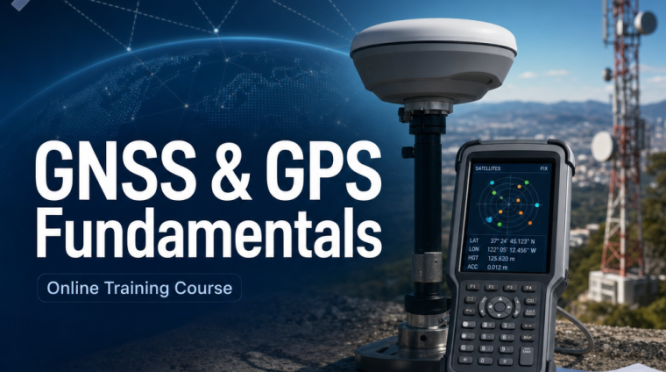
Understand, Install and Troubleshoot GNSS & GPS Systems
Learn how satellite positioning and timing systems work, what affects their accuracy, and how to make informed installation and troubleshooting decisions in the field.
Written by two ex-military industry experts with over 20 years of satellite communication experience, this professional Satoms course builds useful knowledge and confidence while gaining a Satoms GNSS & GPS training certification.
Start Your Training Today
Enroll in GNSS & GPS Fundamentals and begin developing practical satellite positioning skills at your own pace.
Verified Satoms Course Rating
GNSS & GPS Fundamentals
Based on 551 learner reviews
Course Level: Beginner
Course information last reviewed: September 2026
What You Will Learn
This beginner-friendly course connects essential GNSS and GPS principles with the decisions technicians and technical teams face during setup, testing, and fault-finding. By completing the training, you will be able to:
- Explain how GNSS and GPS provide positioning, navigation, and timing information.
- Identify major satellite constellations, system segments, signals, and frequencies.
- Interpret coordinates, datums, height references, accuracy figures, and receiver outputs.
- Evaluate the effects of satellite geometry, atmospheric delay, multipath, and other error sources.
- Compare standalone GNSS, differential GNSS, SBAS, and RTK methods.
- Apply practical receiver, antenna, site-planning, and installation principles.
- Recognize interference, jamming, and timing risks that can affect field systems.
- Troubleshoot common positioning and timing faults using a structured process.
Telecommunications • Mining • Surveying • Construction • Utilities • Transport • Maritime • Remote Infrastructure
Why Train with Satoms
Satoms provides excellent-quality, practical online training designed to turn technical principles into useful knowledge. Rather than focusing only on definitions, this course explains how signals, equipment, environmental conditions, correction methods, and installation choices work together to influence real-world performance.
The training is written by industry experts with over 20 years of practical experience. Clear explanations help you develop a dependable foundation without requiring previous GNSS or GPS training. The self-paced online format allows you to review unfamiliar topics, reinforce important concepts, and build confidence before completing the final assessment.
Real feedback from Satoms learners is displayed separately in the course reviews section, helping prospective students make an informed training decision.
Who This Course Is For
This course is suitable for beginners and technical personnel who need to understand satellite positioning, navigation, or timing systems without unnecessary complexity. It is particularly relevant for:
- Field technicians installing, testing, or supporting GNSS-enabled equipment.
- Telecommunications technicians working with positioning or network timing applications.
- Engineers and technical staff who interpret receiver outputs or accuracy information.
- Survey support personnel seeking a stronger understanding of GNSS and RTK fundamentals.
- Technical learners preparing to enter satellite positioning work.
Course Benefits
Understanding why a receiver produces a particular result helps you move beyond basic status readings and make better technical decisions. The knowledge gained in this course can help you:
- Diagnose positioning and timing issues more efficiently, reducing avoidable field rework.
- Select and position equipment according to signal visibility, site conditions, and operational needs.
- Interpret receiver information and accuracy claims more confidently during installation and testing.
- Distinguish between common correction approaches and discuss their practical applications.
- Communicate coordinate, correction, antenna, and timing requirements clearly with technical teams.
- Apply a repeatable process when investigating unstable, inaccurate, or unavailable service.
Training Certificate on Completion
The course takes approximately five hours to complete and can be studied at your own pace. After working through the training, you will complete a 20 question final assessment covering GNSS principles, signals, accuracy, corrections, timing, installation, interference, and troubleshooting.
A score of 80% is required to pass. After successfully completing the course requirements, you will receive a Satoms training certificate documenting your achievement.
Course Requirements
- No previous GNSS or GPS training is required.
- Basic technical literacy and simple arithmetic skills are recommended.
- Internet access and a device capable of viewing online course content are required.
- Access to a GNSS-enabled receiver or smartphone is optional for practical observation.
Frequently Asked Questions
Is previous GNSS or GPS training required?
No. The course requires no previous GNSS or GPS training, although basic technical literacy and simple arithmetic skills are recommended.
What will I learn in this course?
You will learn GNSS and GPS principles, signals, coordinates, accuracy, correction methods, receiver and antenna installation, interference risks, and structured troubleshooting.
How long does the course take, and is there an assessment?
The course takes approximately five hours and includes a 20 question final assessment. A score of 80% is required to pass.
Will I receive a certificate?
Yes. After successfully completing the course requirements, you will receive a Satoms training certificate documenting your achievement.
What equipment do I need for the online course?
You need internet access and a device that can display the course content. A GNSS-enabled receiver or smartphone is optional for practical observation.
Related Courses
Curriculum
- 6 Sections
- 17 Lessons
- Lifetime
Expand all sectionsCollapse all sections
- Module 1: Satellite Navigation Foundations4 Items
- Module 2: Positioning, Timing, and Equipment4 Items
- Module 3: Accuracy and Correction Methods4 Items
- Module 4: Field Installation and Support4 Items
- Module 5: Course Completion1 Item
- Module 6: Assessment1 Item