CPR and Automated External Defibrillators (AEDs)
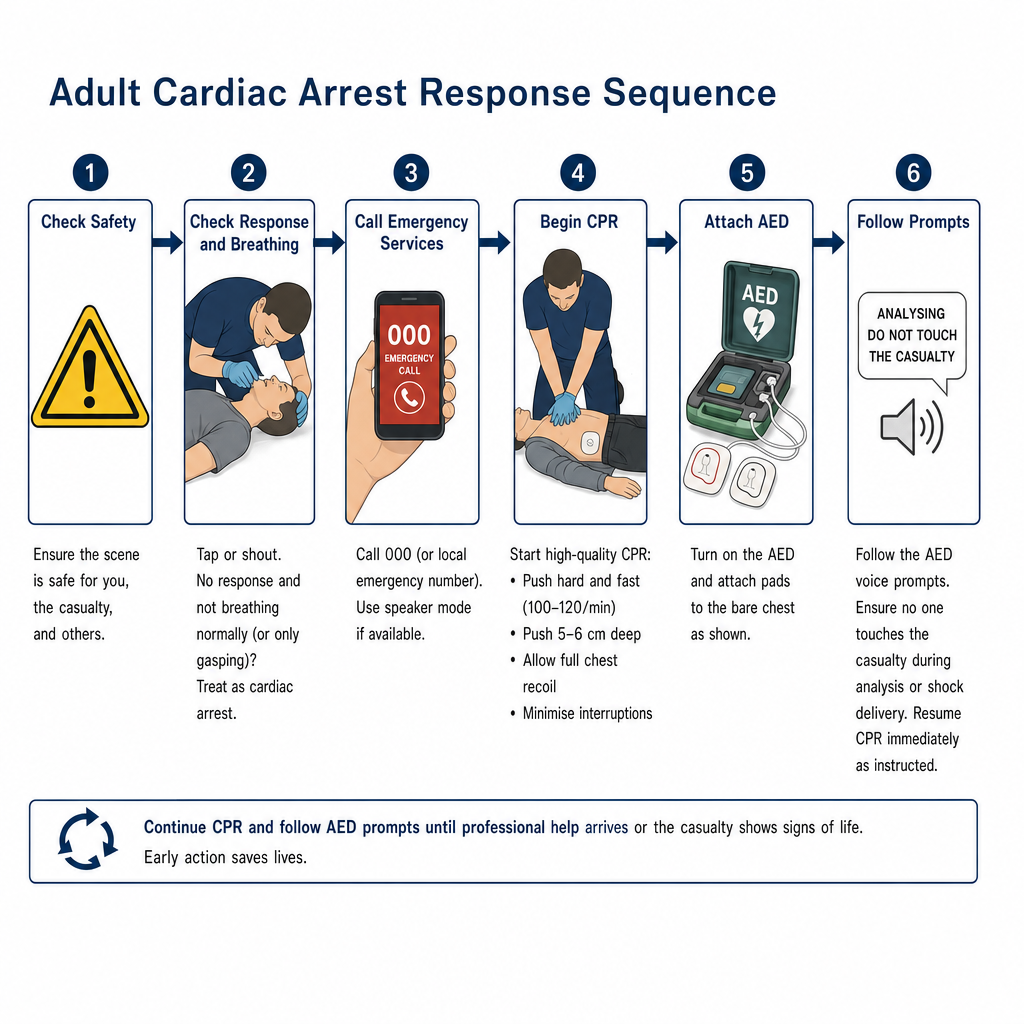
When a coworker’s heart stops, the actions taken in the first few minutes can be critical. You need to recognize cardiac arrest, activate professional help, begin effective cardiopulmonary resuscitation (CPR), and use an automated external defibrillator (AED) as soon as it is available. This lesson explains the adult response sequence; practical training is essential for developing the physical skills and confidence to perform it.
Recognize Cardiac Arrest
Cardiac arrest occurs when the heart suddenly stops pumping blood effectively. The casualty will be unresponsive and will not be breathing normally. Cardiac arrest is different from a heart attack, although a heart attack can cause cardiac arrest. A person having a heart attack may still be conscious and breathing; a person in cardiac arrest needs immediate resuscitation.
After confirming that the scene is safe, check responsiveness and breathing. If the casualty does not respond and is not breathing normally after a brief check of no more than about 10 seconds, treat the situation as cardiac arrest. Occasional, irregular gasps are not normal breathing. Unless your certified procedure specifically requires it, do not delay CPR by trying to find a pulse.
Call for Help and Begin CPR
Activate the local emergency medical service and your workplace emergency procedure immediately. Send someone to retrieve the site AED. If you have a phone, use the speaker function so that the emergency dispatcher can guide you while you begin care.
- Position the casualty. Place the casualty on their back on a firm, flat surface when this can be done safely without unnecessary delay.
- Place your hands. Put the heel of one hand in the center of the chest on the lower half of the breastbone. Place your other hand on top, keep your arms straight, and position your shoulders over your hands.
- Deliver chest compressions. Compress an adult’s chest at a rate of 100 to 120 compressions per minute and to a depth of about 2 inches (5 centimeters), while avoiding excessive depth. Allow the chest to return fully after every compression and keep interruptions as short as possible.
- Add rescue breaths if trained. If you are currently trained and willing, use cycles of 30 compressions followed by two rescue breaths. Give each breath over about one second, using only enough air to produce visible chest rise. Use a breathing barrier if one is immediately available.
If you are not trained, cannot give effective breaths, or are unwilling to provide them, perform continuous chest compressions. Compression-only CPR is much better than taking no action. Follow the emergency dispatcher’s instructions and continue until the AED is ready to analyze the heart rhythm.
Use the AED as Soon as It Arrives
An AED analyzes the casualty’s heart rhythm and determines whether defibrillation—delivery of a controlled electrical shock—may help. It will not deliver or recommend a shock unless it detects a rhythm designed to be treated by the device.
- Turn on the AED. Open the unit and press the power button if it does not start automatically. Listen carefully to its spoken or visual prompts.
- Prepare the chest. Expose the bare chest and dry moisture where the pads will be placed. Apply the pads exactly as shown in the diagrams, usually on the upper right and lower left sides of an adult’s chest.
- Ensure good pad contact. If a medication patch is directly in a pad position, remove it while wearing gloves and wipe the area. Place a pad slightly away from a visible implanted-device lump. Remove chest hair only if it prevents the pads from sticking.
- Clear the casualty. Stop compressions when the AED directs you to do so. Make sure nobody is touching the casualty during rhythm analysis.
- Follow the shock prompt. If a shock is advised, clearly warn everyone to stand clear and visually confirm that nobody is in contact. Press the shock button when prompted, or allow a fully automatic AED to deliver the shock after its warning.
- Resume CPR immediately. Restart chest compressions as soon as the AED instructs you, whether or not a shock was delivered. Leave the pads attached while the device repeats its analysis cycles.
Protect the Casualty and Rescuers
- Do not enter an area with uncontrolled machinery, electricity, traffic, fire, or another serious hazard. Follow site emergency controls before approaching.
- Do not apply AED pads to a wet chest or deliver a shock while the casualty is lying in standing water. Move to a dry location when safe and dry the chest.
- Use gloves and a breathing barrier when available, but do not spend critical time searching for equipment while no care is being provided.
- Never touch the casualty during AED analysis or shock delivery. Contact can interfere with analysis and may expose a responder to electrical energy.
Continue CPR and follow the AED until the casualty begins breathing normally or shows clear signs of life, qualified responders take over, the area becomes unsafe, or you are physically unable to continue. If normal breathing returns, stop compressions, keep the airway open, and monitor the casualty closely.
Workplace Example
A coworker suddenly collapses beside a workbench and does not respond or breathe normally. After confirming that the equipment presents no immediate hazard, you direct one person to call emergency services and another to retrieve the AED. You begin chest compressions. When the AED arrives, a coworker turns it on and applies the pads while you pause only as required. Everyone stands clear during analysis and shock delivery, and CPR resumes immediately after the device prompts you.
Practical Training Matters
Reading the sequence helps you understand the priorities, but it does not replace hands-on practice. Certified training allows you to practice compression rate and depth, rescue breaths, pad placement, and safe coordination with other responders. Know where your workplace AED is located, how it is accessed, and which emergency procedure applies at your site.
Knowledge Check
The AED announces that it is analyzing, but another responder is still touching the casualty’s shoulder. What should you do?
Tell everyone to stand clear and confirm that nobody is touching the casualty. Allow the AED to complete its analysis, then follow its next prompt.
The AED states, “No shock advised.” Does this mean the casualty has recovered?
No. It means the AED has not detected a shockable rhythm at that moment. Resume CPR immediately unless the casualty is clearly breathing normally or qualified responders direct you to stop.
Key Terms
- Defibrillation: Delivery of a controlled electrical shock intended to help correct certain life-threatening heart rhythms.
- Shockable rhythm: An abnormal heart rhythm that an AED is designed to treat with defibrillation.