Overview
Course Content
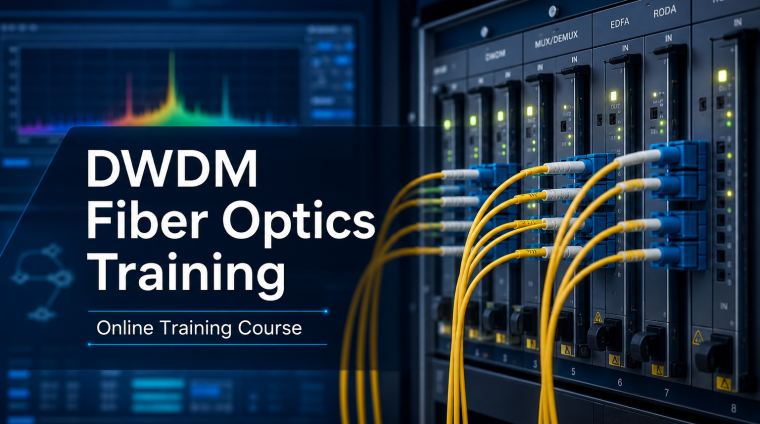
This DWDM Fiber Optics Training course builds practical knowledge of dense wavelength division multiplexing systems, from optical fundamentals and ITU-T frequency grids to commissioning, acceptance testing, performance monitoring and fault isolation. Learn how modern optical networks carry multiple wavelength channels over one fibre and gain the confidence to evaluate optical power, signal quality and common field faults.
Verified Satoms Course Rating
Based on 442 learner reviews
Course Level: Intermediate
What You Will Learn
- Explain DWDM principles, wavelength multiplexing and common C-band and L-band applications.
- Interpret ITU-T channel plans, frequency spacing, wavelength relationships and flexible-grid concepts.
- Identify transponders, muxponders, multiplexers, demultiplexers, OADMs, ROADMs, filters, optical supervisory channels and monitoring points.
- Understand EDFA and Raman amplification, including gain, noise and launch-power considerations.
- Perform optical power checks, loss measurements and commissioning verification.
- Assess dispersion, reflections, macro-bends, connector contamination and power-related nonlinear effects.
- Use optical spectrum, OSNR and equipment performance data to support fault isolation.
- Apply protection, restoration, span engineering and preventive maintenance principles.
DWDM Commissioning and Acceptance Workflow
Develop a structured approach for taking a DWDM link from installation readiness to documented service acceptance:
- Review the design: Confirm the fibre route, channel plan, span losses, amplifier locations, equipment limits and acceptance criteria.
- Verify the passive path: Inspect and clean connectors, confirm continuity and polarity, and evaluate insertion loss and reflectance results.
- Validate equipment configuration: Check transponder settings, wavelength assignments, mux and ROADM paths, amplifier parameters and alarm thresholds.
- Establish optical levels: Compare transmit, receive and intermediate monitoring-point power against the engineered link budget and equipment limits.
- Assess signal quality: Review spectrum, channel spacing, OSNR, dispersion indicators, alarms and equipment performance data using the specified measurement method and bandwidth.
- Test service resilience: Confirm traffic operation, protection switching, alarm reporting and restoration behaviour where required.
- Accept and hand over: Record configurations, test results, exceptions and baseline measurements for operations and future troubleshooting.
Technically Accurate, Practical Training
The course uses correct optical units and engineering relationships. Link power is calculated in logarithmic units as PRx (dBm) = PTx (dBm) + total gain (dB) − total loss (dB). It also explains why optical power alone does not confirm service quality: receiver limits, OSNR measurement bandwidth, dispersion, filtering, modulation format and equipment thresholds must be considered together. OSNR is treated as an important engineering measurement, not as a direct or universal BER result.
Included in This Course
- 100% online training with immediate start
- Self-paced study and lifetime course access
- Straightforward technical lessons with real-world examples
- Integrated AI learning support
- Access to expert instructors and the support team
- 60-day money-back guarantee
- DWDM Fiber Optics Training certificate upon successful completion
Who Should Take This Course?
This course is suitable for fibre-optic technicians, telecom engineers, network operations staff, data-centre professionals, field installers and technical learners who want a stronger understanding of DWDM transport systems and commissioning practices.
Recommended Prerequisites
- Basic knowledge of fibre attenuation, connectors, splices and reflections
- Familiarity with telecom or networking concepts
- Industry experience is helpful but not required
DWDM Fiber Optics Training Certificate
Upon successful completion, you will receive a DWDM Fiber Optics Training certificate recognising the technical knowledge and practical understanding developed during the course.
Related Courses
Frequently Asked Questions
What does the DWDM Fiber Optics Training course cover?
It covers DWDM principles, ITU-T channel plans, optical components, amplification, power and loss measurements, signal-quality assessment, commissioning, performance monitoring and fault isolation.
What commissioning skills are taught in the course?
The course teaches a structured workflow for reviewing the design, verifying the passive path, validating equipment configuration, establishing optical levels, assessing signal quality, testing resilience and documenting service acceptance.
Who should take this DWDM training course?
It is suitable for fibre-optic technicians, telecom engineers, network operations staff, data-centre professionals, field installers and technical learners seeking a stronger understanding of DWDM systems and commissioning practices.
Are there any recommended prerequisites?
Basic knowledge of fibre attenuation, connectors, splices and reflections is recommended, along with familiarity with telecom or networking concepts. Industry experience is helpful but not required.
What is included with the course?
The course includes online self-paced training with immediate start, lifetime course access, technical lessons with real-world examples, integrated AI learning support, access to instructors and the support team, and a certificate upon successful completion.
- 8 Sections
- 32 Lessons
- Lifetime
Expand all sectionsCollapse all sections
- Module 1: Introduction to DWDM5
- Module 2: DWDM Components and Architecture5
- Module 3: DWDM Network Design and Planning5
- Module 4: DWDM Signal Impairments and Solutions5
- Module 5: DWDM Testing and Troubleshooting4
- Module 6: Advanced DWDM Technologies3
- Module 7: Case Studies and Real-World Applications5
- Assessments and Certification1